Wednesday, November 5, 2014

What happens when you give marketing guys too much money (Part 1)

When I interviewed with PokerStars (more on this here and here), one of my concerns was that the company was attempting to go up against the well-established 900 pound gorilla (which was Paradise Poker back then in 2002). The big issue with attempting to fight a 900 pound gorilla is that you need to be able to act like a roughly 900 pound gorilla yourself. Popping a few ads into Card Player wasn't going to be sufficient - we were going to need to be very creative, and in this context, there's a pretty simple equation:  

creativity = lots of money

One of the tasks I performed for Isai before he hired me was to create a marketing plan - not a full-fledged plan, but he wanted me to sketch out details about how I would go about launching the company. As part of this exercise, I created a marketing budget, which involved spending about $600,000 on marketing in year one. I had no idea what PokerStars' financial backing looked like, nor did I know at the time who the owners/investors were other than Isai. I wasn't thrilled with where I was working, but leaving a reasonably well-paid position with an up-and-coming Internet company for a startup was already going to be a challenge - I needed to know that they had deep enough pockets to have a chance in the market.

At some point in the interview process, Isai asked me if I had any questions. I asked, "You've read my marketing plan. Do you have $600,000 to spend on marketing in year one?" Without skipping a beat, Isai said, "We have the money we need to properly launch this company."

Had this been anyone else, I would have had a lot more questions. But there was something about Isai that I simply trusted implicitly. This may seem naive from a nearly-fifty-year-old (at the time), but I've come to rely on my business sense, and there was no doubt in my mind that PokerStars had the resources to carry out an audacious plan.

I'll start with a modest example. After Chris Moneymaker won the 2003 World Series of Poker, I was constantly looking for ways to capitalize on his extraordinary accomplishment, and to leverage his name (which was, frankly, a dream for a marketing guy). After the first few broadcasts of Chris' final table, he was instantly recognizable, so one thought was to experiment with some pure branding around his name. I had this idea for a billboard that would directly tie Chris' success to his experience on PokerStars. I took one of our standard layouts, played with it a little and came up with this:


I thought the tagline was one of my best - it directly linked Chris with PokerStars, broadly implying that he won the WSOP because of us. I sent the design off to our staff artist and started shopping around for billboard locations around LA, thinking that we would use one of the world's largest poker markets as a test.

Around this same time, we got into some very contentious discussions with the owner of the Bicycle Casino, Haig Kelegian. Kelegian owned the Bike, Oceans' Eleven near San Diego and part (later most) of the Commerce Casino, and was an insufferable jerk of almost unimaginable proportions. The last meeting we had started off with Kelegian, in front of five of his own staff, saying, "Companies like yours are illegal, and I can put you out of business with a few phone calls." This pronouncement, I kid you not, was immediately followed by his request (through Kelley O'Hara, his marketing director) that PokerStars run satellites for the Bike's upcoming tournament series.

If that's not outrageous enough, what followed literally made my jaw drop. I told Kelegian, O'Hara and the rest of his team that we might be willing to run satellites for them, but that we needed to work out how we could mesh the brands together so we could each gain some benefit. Kelegian then told me that we couldn't use the Bicycle Casino's name or logo to advertise satellites. When I asked him why we would send a few hundred thousand dollars of our liquidity to the Bike for essentially no return, he said the following: "Your players will know, and our players will know. You should be happy just to be associated with us."

No shit, he actually said this.

In the car on the way home from this complete waste of time, I got a call from Marc Chessen, who owned a media company we had done some business with. I had asked him to look into the cost of a small number of billboards that we could use as a test. He was calling to give me the estimate, and to tell me that there were two particular billboards we might like - they were on the 710 Freeway, on the approaches to the Bike from both north and south. 

"How far are they from the Bike?" I asked.

"You could throw a rock from either one and hit the Bike," Marc answered.

Life isn't always perfect, but then there are moments like this. 

"I'll take both of them," I said. Marc pointed out to me that he hadn't told me the price. It didn't matter. Three weeks later, Haig Kelegian got to look at this on his way to the office.


This escapade cost PokerStars $30,000 a month, plus the cost of the boards (we did a total of six, including one at the exit from the Commerce). Isai wasn't convinced about doing a branding campaign - he believed that our money was better spent in direct response until we were better-known. But I believed that Moneymaker's brand would help us rise to the top, and was willing to take a chance.

There's a nice epilogue to this story. We regularly surveyed our players to find out how they had heard about us and what made them sign up. Within a few days of putting up the billboards, we started to see measurable numbers of players saying that they first learned of PokerStars from the billboards. By the end of the first full month, over 200 players claimed that the billboards brought them to PokerStars. My branding campaign had, inexplicably, become a direct response campaign.

And there's one final, satisfying note. It was a few years before we tried to do anything with the Bike again, and this time it was them approaching us. By 2005, we had three WSOP champions in our stable, were one of the three dominant brands (along with PartyPoker and Full Tilt) and were, in real dollars, larger than the Bike by a substantial margin. Kelley O'Hara asked us to work with them on satellites and other promotional opportunities surrounding their World Poker Tour event, which we did (and used their name). In the last meeting before we launched, we hammered out the final details and I thought we were done. As I was packing up, Rick Cloward (who, I think, was VP Operations) asked if he could speak with me privately. When we reached his office, he closed the door and said just one thing: "Would you please take down those fucking billboards?"


I have written before about the horrific series of events leading up to our first World Poker Tour event, conducted on a cruise ship in January 2004 (see "How I almost went to jail as a terrorist," "Revenge of the Girlfriend" and other related stories). Without rehashing those stories much, I'll mention that I had to fire our travel agent a few weeks before the event, which meant taking on far more work than our microscopic staff was able to handle. We were all working 18 hours a day with no respite in sight until after the cruise.

In the middle of all of this panic, I got an MSN Messenger message from Isai (this was our preferred means of communication for most things). He had heard that Sharon had played quite a bit of poker with Ben Affleck, and asked me if I thought she could get him to come on the cruise. I told Isai that I doubted that Sharon knew him well enough, but I'd ask her opinion.

The next time we went to the Hustler to play, there was Ben. Sharon approached him with the idea, and much to our surprise, he was not only interested, but seemed excited at the prospect. He gave Sharon his agent's contact information and told us to work out the details with him.

I called the agent the following day, and he took my call immediately - Ben had already told him to expect my call. I gave him my pitch, he asked a lot of questions and then said he'd talk to Ben and get back to me.

The next morning, he called. Ben would love to go on the cruise, and he had just enough time in his schedule to do it. And then he dropped a bomb - he wanted a $1 million appearance fee. 

There was no way this was going to happen. $1 million was a very measurable chunk of my marketing budget, and I honestly didn't think there was anywhere near that much value in having him along. But I told the agent we'd talk about it. I hung up and called Isai.

"OK, I talked to Ben Affleck's agent. He wants a $1 million appearance fee." Without missing more than a half-beat, Isai said, "OK, work out the details," and hung up.

So now, in addition to personally making travel plans for the roughly 600 people going on the cruise with us, I now got to negotiate and execute a seven-figure deal with arguably the biggest star in the world. I got to work on the contract with our lawyers, and started working out the logistics. I called the agent after we sent the contract along, and he dropped the next few bombs.

"Ben doesn't travel commercial. You need to fly him from LA on a private jet. I'll send you the specs," he said. They arrived while we were talking - Gulfstream IV or comparable, two wait staff, no one else other than the pilots and whoever Ben brought along.

"OK," I said, having no idea whether or not this was OK. "What else?"

"Ben doesn't want to board with the rest of the passengers on the cruise." I told him that wasn't a problem - we'd board him first, or last, whatever he preferred.

"No, he doesn't want to board at the pier. You need to arrange to fly him to the ship."

By this time, I was in so far over my head that a little more wasn't going to change things much. "OK, what else?"

He sent me a list of relatively minor things - his cabin requirements, getting him from the hotel to the ship, stuff that seemed downright trivial in the face of hiring a helicopter to fly to a moving cruise ship. I told him I'd call him back later in the day.

My first call was to Royal Caribbean. I had no idea if landing a helicopter on a cruise ship was even conceivable. As it turned out, they had done it before, more than once, and yes, it could be done. However, there were two other things that we needed to consider:

(1) They don't allow helicopters to land while the ship is moving except in dire emergencies. So, they would stop the ship for the landing, but it takes an hour to come to a full stop and an hour to get moving again. Cost to us: $200,000.

(2) We needed a permit from Homeland Security, which normally took a minimum of two months. However, my RCCL rep knew someone at DHS and thought she could get it through.

I called Isai again with some revised numbers. Including Ben's appearance fee and all of his demands, the cost of bringing him on the cruise was now just over $1.4 million. 

"OK, do it," he said. Just like that. And my first thought was what's it like to spend $1.4 million by just saying "Do it?"

In the end, we didn't do it. The DHS security certificate was most of the reason - despite my RCCL guy's assurance, there was no guarantee we'd get the permit in time, and we might easily be committed to over a million dollars in expenses and no way to get Ben onto the ship. I breathed a huge sigh of relief - I was never really sold on the idea in the first place, and honestly didn't know if I'd get through the whole experience without having a stroke.

Click here for Part 2.


Saturday, August 30, 2014

How Caesars saved the World Series of Poker (Part 2 of 2)

[Note: regular readers of my blog know that I made a commitment a while back about posting at least once a week, with the penalty being a $100 contribution to charity. I backed off on this during the WSOP, as that is my busiest time of year, and continued to slack through BARGE (my favorite week of the year - more about BARGE here). But I'm back now, and the charity penalty is back in effect. If more than a week passes between posts, email me or post a message here; the first one to catch me can designate the charity to which I'll contribute $100. Oh, and don't get a stick up your butt about "a week" - if I post something on September 2 at 3p, don't start emailing me at 3:05 on September 9. 12:01 on September 10 is acceptable.]

There is no generally accepted date on which the poker boom started. If you asked me, I'd say the the seed of the boom was planted the day the first hand of online poker was dealt, it took root the day of the first World Poker Tour (WPT) broadcast (March 30, 2003) and sprouted the day Chris Moneymaker's World Series of Poker win was first broadcast (August 2003, although I'm unable to find the exact date). But in fairness, the World Series of Poker (WSOP) has always been at the heart of the poker boom. Had it not been for Harrah's, that heart would have stopped beating on January 9, 2004, when Binion's was raided by the IRS, the Nevada Gaming Commission and Federal marshals.

[Kudos to Keith F. for a clever edit of the above paragraph.]

I described some of this in Part 1 of this article. The timing of the Binion's raid was bad for all involved - it was less than four months before the 2004 WSOP (which always ended the Friday before Memorial Day back then) and just a few weeks before the first regular episode airing of WPT Season 2. And if you think this is a spurious detail, remember that booms and busts turn on small matters - and these weren't exactly tiny.

From my perspective, this was bad for different reasons. PokerStars had just achieved a monumental success at the 2003 WSOP, had just been invited to join the WPT and were just days away from our first WPT event on a cruise ship, some of which you'll find chronicled here and here. We had massive promotions planned for the 2004 WSOP, which were scheduled to launch in early February. As far as I knew, we might be running satellites to a tournament that wouldn't happen.

Lee Jones and I sat down to discuss this possibility during the PokerStars Caribbean Adventure cruise. We came to the conclusion that someone would rescue Binion's and the WSOP. We briefly speculated on who might come forward, if anyone. Our plan was to launch satellites for the 2004 WSOP as soon as the cruise was over, which would include $10,000 Main Event entries plus cash. We decided that, in the worst case (no WSOP), we would just give players $10,000 in cash.

To our great relief, Binion's reopened under the temporary management of Harrah's on April Fool's Day 2004. It really wasn't clear in those first few days what Harrah's plans were - they weren't exactly a power in the Las Vegas poker scene. We really weren't even sure if they understood the value of the WSOP property they had bought along with the casino. 

Fortunately, it immediately became obvious to all of us that both Harrah's and ESPN were taking the WSOP very, very seriously. The first hint we had of this: Lee and I were invited to a meeting at Binion's in mid-April to help Harrah's and ESPN figure out (1) which WSOP events made sense to broadcast, and (2) how to show non-hold'em events on television.

ESPN brought their heavy hitters to the meeting, including Matt Maranz, the self-effacing head of the WSOP production company (441 Productions). Harrah's sent a team of executives, most likely the engineers of the acquisition. And Harrah's did something that I found extraordinary, especially given the scope of the investment they were making: they just shut up and listened to the experts.

Harrah's was in a very interesting spot. By April 2004, all the symptoms of a boom were popping up. 7-11 and Wal-Mart were selling cards and chips. Poker books became best-sellers on Amazon. Hastily produced poker television had already popped up in the form of poorly produced and not very interesting (US Poker Championships), decent concept with poor execution (Poker Royale) and downright silly (Celebrity Poker Showdown). And celebrities were emerging, complete with nicknames. Suddenly, normal human beings knew names like Howard "The Professor" Lederer, Chris "Jesus" Ferguson, Barry "Robin Hood" Greenstein, Phil "Poker Brat" Hellmuth and Men "The Master" Nguyen. Harrah's knew that there was, at least in the short term, a nearly insatiable appetite for poker on TV.

The executives at Harrah's patiently watched us audition more than a dozen different poker variants beyond no limit hold 'em, all of which were regular WSOP events (limit and pot limit hold 'em, Omaha, Deuce to Seven No Limit Draw, Seven Card Stud, Razz and more). No one was sure that events like these, particularly the lowball variants, could even be shown on TV in a manner that made sense. Perhaps the biggest problem was that each broadcast of a non-hold 'em game would need to teach the game to the audience, a daunting task for some of the more esoteric games.

But to Harrah's credit, they took the plunge, as did ESPN. The 2004 WSOP broadcasts were esoteric but instructional (which, as ESPN found, is good if you have a poker audience, but not this early in the boom), and included an extraordinary range of games. In addition to 'specialty' events like the $1,000 buy-in No Limit Hold 'em Ladies' Event, ESPN and Harrah's produced and broadcast events featuring Pot Limit Omaha, Seven Card Stud High, Limit Hold 'em, Razz and even Kansas City Lowball (Deuce to Seven Lowball, single draw, played no-limit).

I have to admit that I was very skeptical about these shows. And I was proven wrong - they were surprisingly popular, possibly as a result of final tables like the $5,000 rebuy Kansas City Lowball event. This table of seven included Howard Lederer (2 WSOP bracelets at that point), Chris Ferguson (five, including the 2000 Main Event), Barry Greenstein (who would win the first of his four in this event), Steve Zolotow (not as well known as the others, but should be, with two WSOP bracelets), Chau Giang (three) and Lyle Berman, founder of the World Poker Tour (three). The game itself might have been obscure and confusing, but the players were smart and entertaining, and it made for good television.

[Note: despite respectable ratings for the non-hold 'em events, this was the only year in which ESPN broadcast this many of them. As it was explained to me, the combination of more expensive production and some confusion on the part of viewers convinced them to focus on hold 'em and Omaha (although they did broadcast some Stud events moving forward).]

Harrah's made the decision before the 2004 WSOP to seek high-end sponsors for the event, something Binion's never had the marketing savvy to consider. This was the first ambitious step towards making the WSOP a top-tier sporting event. Many of us laughed at their first sponsor - the prescription erectile disfunction drug Levitra. The range of Levitra jokes seemed limitless - "please hold up, please hold up," "I've got a big one!" - but the truth is that with Levitra, Harrah's reeled in a deep-pocketed sponsor in GlaxoSmithKline and set the stage for even bigger sponsorships as the WSOP grew.

One of the most common criticisms of Harrah's and the WSOP in the years since 2004 has been that, while they have landed high-end sponsors willing to spend millions (GlaxoSmithKline, Milwaukee's Best, Jack Link's Beef Jerky and others), they haven't shared this largesse with players, who put up their own money to play in the WSOP. This is an oddly misplaced criticism. The WSOP grew astronomically from 2004 (2,576) to 2006 (8,773), and even at 2014's lower numbers (6,683) it's still the largest prize event of any kind anywhere in the world. This didn't happen by accident. Harrah's poured tens of millions of dollars and the effort and time of thousands of people to make the WSOP the monumental event it is today. And this, in turn, created massive opportunities for poker players, both in WSOP events and in the thousands of other tournaments and cash games that now happen in conjunction with the "WSOP season."

Here's an example of a savvy decision Harrah's made back in 2005, the first year that the WSOP was played at the Rio (other than the final table, which was at Binion's one last time). They gave the Rio Convention Center to the WSOP, knowing that they were likely to see 5,000 or more players in the Main Event. But in addition, they dedicated 60,000 square feet of convention space to the (somewhat unfortunately named) WSOP Lifestyle Expo. The Expo was a trade show for the poker business - online sites, clothing companies, chip and card makers and dozens of other companies showing off their wares during the first few days of the Main Event. And they did participating companies a huge favor by routing all WSOP traffic through the Expo area before reaching the gaming floor, ensuring that every player and spectator at the WSOP was exposed to the Expo floor.

And the floor was, in fact, pretty compelling. Almost every online site was represented in a big way. Bodog, for example, had a two-floor booth featuring Calvin Ayre's Harley-Davidson on the first floor and a gigantic bed, complete with models in nighties, on the second floor (I understand there were pillow fights involved, but I have no personal knowledge of this). The Expo became a gigantic, excessive party celebrating the peak of the poker boom.

Everyone benefited from this smart marketing by Harrah's. While floor space was quite expensive, the sheer volume of traffic (estimated at 30,000 people per day) made it a winner for vendors. Spectators and players alike loved it, since they were able to find WSOP souvenirs, chips, cards, books, table covers, poker tables and pretty much anything poker related all under one roof. And it raised awareness of poker even higher than it already was. It was the Ringling Brothers of Poker, a true circus atmosphere for a game that richly deserved a giant, gaudy party.

Viewed from the outside, it's easy to second-guess Harrah's decision to buy the WSOP and market it - they cherry-picked the best poker property in the world and commercialized it. But the massive investment they made in this property is only a slam-dunk when viewed from the present. Harrah's took a huge risk, both financially and in reputation, by taking on the WSOP. The World Poker Tour had momentum, attention and money, and the WPT Championship (a $25,000 buy-in event) was growing at a similar rate to the WSOP Main Event. But Harrah's made the WSOP a global property, and a global brand, through smart marketing.

If you read this blog regularly, you know that I am not Harrah's (eventually Caesar's) biggest fan. If you want an example of the sort of torture we endured from Harrah's back in the boom days, read The Girl with the $16,000,000 purse. But the truth is that Harrah's saved the world's foremost poker tournament from obscurity, and then turned it into every poker player's dream. And for that, all poker players, even me, should take our hats off.

Friday, July 18, 2014

How Caesars saved the World Series of Poker (Part 1 of 2)

[Author's note: I have received many emails, tweets and texts about my last post, which excoriated Caesars for its management of the World Series of Poker. One thing that I need to make crystal clear: I no longer work for PokerStars, and have no dog in this hunt. My reactions to Caesars' WSOP issues is partly personal (as a player) and partly professional (as a marketer). As I left PokerStars many years ago - in 2007 - none of my comments are biased by my position as a competitor. In fact, since I would have had no credibility, I would never have written any of this during my tenure at PokerStars.]

A few weeks ago, I posted a story entitled "Six ways Caesars screwed up the World Series of Poker," which has become the second most popular post on this blog (after "Armadillo Tim and the Threat of Death," which has now had almost 50,000 60,000 page views). I've gotten more emails about this story than any other. The story came mostly out of my frustration with Caesars' lack of understanding of their players. I have no problem with the blatant commercialism of the WSOP, as some have suggested; it's not a religion, it's a game. Commercialize it all you want, Caesars - just remember who brung you to the dance.

There are two sides to most stories, and there are two sides to this one, as well. This time around, I want to give Caesars (then Harrah's) credit for rescuing a storied franchise from what might have been obscurity.

The WSOP has been around since 1970, although arguably it really started in 1971 - the 1970 WSOP consisted of seven players, who played cash games and then voted Johnny Moss as the champion. It was the brainchild of Benny Binion, legendary gambler, entrepreneur and convicted murderer, who never lacked clever and creative ways to draw attention to Binion's Horseshoe. Prior to the WSOP, Binion's primary claims to fame were its display of $1 million in cash (a hundred $10,000 bills, at the time the largest private collection of the rare bills) and Benny's willingness to take a bet of almost any size.

[Historical note: before you email me to suggest that the famous heads-up match between Johnny Moss and Nick "The Greek" Dandalos was the third notable event at Binion's - most historical accounts agree that the match probably took place in 1949, two years prior to the opening of Binion's Horseshoe. It was most likely played at the Las Vegas Club, in which Benny Binion had a significant interest.]

The WSOP began as an event for the world's elite poker players. The $10,000 buy-in Main Event grew very gradually from its inception in 1971 through 1983, when Eric Drache, cardroom manager at Binion's and tournament director for the WSOP, came up with the ground-breaking concept of satellite tournaments, in which players could play for much smaller amounts, as low as $200, and win entries into the Main Event. This boosted WSOP Main Event entries in a big way - from 1983 to 2002, entries in this prestigious event grew from 108 to 631.

2003 saw a huge jump in registrations, owing almost entirely to online poker sites like PokerStars and PartyPoker contributing substantial numbers of entrants. When cards went in the air for the 2003 Main Event, 839 players had registered, nearly eight times the total number of players in 1983.

The 2003 World Series of Poker kicked off the poker boom in earnest. I won't retell that story here; if you've been under a rock for the last eleven years, you can Google "2003 WSOP" for more information. You can also find a number of my stories from that year in these prior posts:

Dancing with Moneymaker
How Olof Thorson broke my heart, and made history
2003 WSOP: The last lap to the final table
Poker's tipping point: the 2003 WSOP final table
How the Moneymaker Effect almost didn't happen

By January 2004, poker rooms all over the world were operating beyond capacity. Casinos in Las Vegas that had shuttered their (largely unprofitable) rooms years ago reopened. The World Poker Tour and the World Series of Poker TV broadcasts were returning astounding numbers. It was a unique time to be in the poker business...unless you were Binion's Horseshoe.

For years, Binion's had been in trouble with the IRS and the Nevada Gaming Commission for a wide variety of offenses, including non-payment of taxes, non-payment of pension and insurance benefits, allowing barred individuals on property (including Nick Behnen, the husband of Becky Binion Behnen) and failure to maintain regulatory minimum cash balances. So it was disturbing but not shocking when, on January 9, 2004, a joint task force composed of IRS agents, federal marshals and representatives of the NGC stormed Binion's and shut down the casino and hotel.

Everyone wondered if this was the end of the storied World Series of Poker, but we only had to wait two days to learn that the legendary tournament would, in fact, survive. On January 12, Harrah's Entertainment, Inc. (the predecessor of what is now known as Caesars Entertainment) announced that it had acquired Binion's, would take full responsibility for its debts, would reopen the casino and would conduct the 2004 WSOP. 

Uneasy weeks passed with Binion's remaining shuttered. Harrah's made reassuring statements, but it was unclear what the impact would be on the WSOP and the Binion's property. As Harrah's delved more deeply into the assets of the troubled property, they made a shocking discovery: not only did Binion's not own the land on which the Horseshoe resided, portions of it were owned by nearly 100 separate entities, some individuals and some corporations. These entities has all signed 100-year leases which were now called into question as a result of the raid and subsequent acquisition.

Harrah's never intended to maintain ownership of Binion's. Within days of the January 12 deal, rumors circulated that Harrah's intended to sell the casino to MTR Gaming Group, owners of the Speedway Casino in North Las Vegas as well as two out-of-state racetracks. On February 20, details of the mess with land leases emerged, as did more information about Harrah's plans - they had agreed to operate the casino for MTR for one year, with two one-year extensions, and would keep the WSOP downtown until 2005, the year of Las Vegas' Centennial. 

Some light peeked through the end of the tunnel on March 4, when the Nevada Gaming Control Board and the Nevada Gaming Commission, who had worked with unprecedented haste, approved the sale of Binion's to Harrah's and MTR. The land issues still hadn't been worked out, though, and Binion's remained closed. The land problem appeared to be getting worse, though, with rumors (later found to be true) circulating that a single landowner holdout was demanding a massive payout.

And just as suddenly as Binion's closure, the logjam broke. Details are hard to come by, but on March 28, just weeks before the 2004 WSOP, the sale closed, and three days later (yes, on April 1), Binion's reopened for business. The 2004 WSOP would, in fact, happen, and its growth from 2003 would stun the industry, and perhaps Harrah's most of all.

Next: Harrah's turns the WSOP into a franchise

Sunday, July 6, 2014

The most fun you'll have playing poker this year

I've been playing poker for more years than I really want to think about. I've played in home games, casinos, poker rooms, parties, even hospital rooms. I've played in tournaments and cash games, live and online. So when my friend and fellow poker player Lou Krieger started pushing me to go to a poker convention called BARGE, I couldn't imagine that there was anything I'd experience there that was substantially different.

I was so, so wrong.

Lou started cajoling me about going to BARGE back in 1997, when we were both playing regularly in limit hold 'em games at Hollywood Park. I had several friends that went every year. I finally got a little taste of what I might be missing when I attended ESCARGOT, a smaller version of BARGE held at Crystal Park in 1999. It consisted of about 60 people, all rabid poker players, who were there for one reason: to have fun playing poker.

From 1997 to 1999, I made a substantial part of my living playing poker. One of the unfortunate side effects of playing poker for a living is that the game loses most of its fun aspects - it's a living, not a game. ESCARGOT reminded me that poker can, in fact, be a lot of fun. But it was three more years before I attended BARGE and finally got what all the fuss was about.

[Historical note: BARGE stands for Big August Rec Gambling Excursion. BARGE originated with a handful of members of a Usenet newsgroup, rec.gambling.poker, or RGP, in the early 90s. RGP still exists, although the signal-to-noise ratio is so low that it's no longer a good source of information about poker. But BARGE, thankfully, survived.]

I had started working for PokerStars in early 2002, and during the summer a friend mentioned that there was an opportunity to sponsor BARGE. BARGE consisted of about 200 poker players, a small audience, but clearly an influential one. I seized the opportunity. I didn't attend the entire event, but the organizers gave me a chance to speak a few times (I was giving away nice PokerStars swag). What I saw during the BARGE Main Event convinced me that I had to attend the next year.

There was a surprising number of well-known poker players who were part of this group. I recall seeing Andy Bloch, Chris "Jesus" Ferguson, Russ Rosenblum (fresh from his WSOP Main Event final table appearance that year), a few members of a group of crazy gamblers called the TiltBoys and other recognizable faces. As I watched these guys and the rest of the community play, I realized that I was watching world-class players playing a $100 event with just as much intensity as they played in the WSOP.

Shortly after the Main Event started, I heard some applause start, and eventually it became cheers and loud applause. I asked someone what that was about, and he told me that someone had just busted out. A BARGE tradition is to applaud players as they bust out, and it's done in an almost entirely sincere and respectful way. The first bustout seems to get substantially more applause, ostensibly because the rest of the group is relieved not to be out first.

As I walked around the tables, I noticed that many players had one or more trinkets on the table, and I'm not talking about card cappers. There were stuffed animals, CDs, DVDs, pieces of jewelry, shot glasses, goofy Las Vegas tourist items - and no common thread. I couldn't figure out what this was all about, so I asked, and learned about another BARGE tradition.

"Those are bustout gifts," another BARGEr patiently explained to me. "When a player busts out of the Main Event, he or she gives the bustout gift they've brought to the person who busted them." I found this charming, and oddly moving. It showed respect for the game and the other players, something sorely lacking in the games I was used to.

BARGE is held at Binion's in downtown Las Vegas. It's been moved around a few times, mostly because of the problems Binion's had in the mid-2000s, but it's been at Binion's consistently since 2007.

2003 was my first year as a real member of the BARGE community. The 'formal' part of BARGE consisted of a handful of tournaments, mostly games I knew - there was a Tournament of Champions format event (limit stud, limit hold 'em, limit Omaha High/Low), a California Lowball event, a video poker tournament, a few others that I don't recall and a No Limit Hold 'em "Main Event." None of the tournaments had buy-ins higher than $100; if I recall correctly, my total outlay for all of the tournaments I played was about $300.

When tournaments weren't going on, there were non-stop cash games, some the usual limit hold 'em, some pretty unusual. That first year, I learned one new game, a bizarre variant on Hold 'em called Chowaha. Chowaha is usually played with two cards, just like Hold 'em, but you have to use both of your hole cards. The dealer then deals three flops, after which there's a round of betting. Then there are two turns and one river, each followed by a betting round. At the end, the board looks like this:


You can play any of the three flops. If you play the top flop, you can play the top turn card; if you play the bottom flop, you can play the bottom turn card. If you play the middle flop, you can choose from either turn card, and in any case you use the single river card.

Over the years, many additional strange games have been added to the mix, some with obvious names (Second Best Hold 'em), some with entirely inscrutable names (Scrotum, which is played either N or N-2, Oklahoma). I was even involved in the creation of one of these games - Binglaha, which is Pot Limit Omaha, but whether you're playing high-only or high-low is determined by a die roll after the flop betting is complete.

In addition to the scheduled events, there is a wide range of unofficial, sometimes ad hoc events. There's a midnight $1 craps crawl. There's a breakfast at a classic Las Vegas place called The Egg and I. There's a sushi dinner, and an Ethiopian dinner. There's a Fun Run (although what's fun about running in 100 degree Las Vegas heat is beyond me). There's a cigar smoking/bourbon tasting event. And new things spring up all the time, shaped by the varying personalities of the group. 

And there's a notable appearance of anarchy that I have always found particularly charming. There's no registration desk - you pick up your badge from the desk at the poker room. There are no opening or closing ceremonies. BARGE starts when people arrive, and ends when they leave. It's very well-organized, but the machinery is so well hidden from attendees that it appears to run itself.

Since 2003, while Sharon and I have been inconsistent about taking vacations, the one week we always take off is the first week in August. It is, without a doubt, the most fun I have playing poker all year.  I can't recommend BARGE highly enough - many of my closest friends have come from this group, and while we may only see one another once a year, it's during a week of a game we love, playing for bragging rights and pure enjoyment.

If this post has developed as an obvious ploy to promote BARGE, I offer no apologies. Come join us. You'll thank me. You can register for BARGE by clicking here. [NOTE: this link was changed to reflect the correct 2015 registration page.]

And make sure to come find me. I'll be the bald guy playing Binglaha.

Thursday, July 3, 2014

Six ways Caesars screwed up the World Series of Poker

Every June, the biggest event in the poker world kicks off at the Rio in Las Vegas. In fact, not only is the World Series of Poker the largest poker tournament in the world, it's the largest tournament of any kind in the world. It's bigger than anything on the PGA circuit, the professional tennis circuit, any circuit. In 2013, the WSOP edged very close to $200 million in total prize money. This number is even more staggering when compared to the paltry $22 million in total prize money in 2003, the last year the WSOP was owned and operated by Binion's Horseshoe.

With total prize money up by almost 900%, how outrageous is my claim that Caesars (then Harrah's) has screwed up the WSOP?

Looking at the WSOP purely from a numbers perspective, the WSOP has been a massive success for Caesars. But don't let those numbers fool you into thinking that Caesars stewardship of the WSOP since 2004 has been all, or even mostly, good for players. A substantial part of the massive growth of the WSOP would have happened regardless of management of the event - you only need to look back to 2005's Celebrity Poker Showdown to realize that anything containing the word "poker" succeeded during the heart of the poker boom. Caesars didn't create the poker boom. They were, I admit, smart enough to recognize its potential, and did use their considerable market heft to bring it more into the mainstream. 

[Note: for a counterpoint to this article, see my later two-part post, starting here: How Caesars saved the World Series of Poker.]

So what exactly did they do wrong?

Following is a far-from-exhaustive list of the mistakes that Caesars has made in managing the WSOP. There are many more; I chose these because they are the easiest to see if you're a first-time visitor to the event, and they're the major irritants that I hear about most from players. These are listed in no particular order.

[Note: in the first draft of this article, I listed eight mistakes, but in re-reading them, I decided that two of them were petty and removed them. I'm only mentioning this because the permalink for this page says "8 ways...," which is how I saved the first draft - the permalink can't be edited.]

1. Prices. The Rio has made it very clear to poker players that they are there to squeeze every possible dollar out of the player. You'll see this the first time you buy a $1.50 banana [SteveB notes that several venues charge $2.50] or a $2.50 bag of M&Ms. 

I don't begrudge the Rio for charging exorbitant prices for swag - that's what swag is for. Be prepared to pay $30 for a t-shirt and $25 for a hat. If you go to the Bellagio gift shop, you'll pay $25 for a hat, too. But many poker players are at the Rio for extended periods during the summer, and at $10+ for a hot dog, their outrageous prices add up.

I'm a little surprised that there hasn't been a player revolt over this. The first year the WSOP was held at the Rio (2005, except for the final table), they tried to charge players for drinks, but that was short-lived as a result of massive backlash from players.

2. Rake. This could be combined with #1. The Rio charges 10% rake up to $5 (vs. the $4 max in their regular poker room), but that's not the bad part. If there is money put in the pot voluntarily, they rake the pot for the full rake, including uncalled bets. For example, let's say you're playing $2-5. One person limps, then you make it $30. Everyone folds. From the Rio's point of view, there is $42 in the pot, and they rake $4, even though $30 of it is your uncalled bet. So the part of the pot that represents money won by you is $12 (the blinds plus the limper), and the Rio takes 1/3 of it.

(Related note: I played $1-3 a few days ago while waiting for another game, and it was in this game that I became aware of this problem. Players in the $1-3 game, for whatever reason, tend to raise a larger multiple of the big blind than in most games, and in this case, a player made it $42 to go. Everyone folded. The dealer took $5 from the player and put it on the drop slot. I stopped him and said, "Is this really the rule here? This player is going to lose $1 because you're raking a bet that no one called." He said yes, and I asked him to call the floor, who happened to be someone I know. The floor confirmed that this was the rule, but in this case chose to return the $5 to the player.)

3. Marginal staff. I'm going to admit up front that this is a tough one. The WSOP drains every poker resource within 400 miles of Las Vegas, and regardless of any criticisms I may make, pulling off 65 bracelet events, hundreds of side tournaments, satellites, cash games and everything else is a Herculean task. I know, because I've done it on a smaller (but still substantial) scale during five years of the PokerStars Caribbean Adventure.

That having been said, Caesars owes it to the poker community, which contributes millions to Caesars during the WSOP, to get this right. For the most part, dealers this year are average, which is a huge leap from prior years. I still saw dozens of dealers who barely understood poker, much less dealing. In a particularly egregious example, I played 5-5 Pot Limit Omaha a few weeks ago with a dealer who came into the box, looked at the game plaque and said, "What's pot limit mean?" We patiently explained, finally telling her that we would just tell her what to do. At the end of her down, she pushed to the top section 10-25-50 PLO game. I suspect she was never heard from again.

Floor staff is a much bigger problem. While I have seen a number of floor people that I know this year, the sheer numbers that the WSOP requires creates situations in which inexperienced floor staff make offhand, incorrect decisions that can cost players thousands.

One example: a coworker of mine played in Event #1, the Casino Employees Event, and had gone quite deep - when this hand happened, there were about 50 players remaining of the starting field of about 850. He was pretty short-stacked, with about 20 big blinds, and was waiting to pick up a hand. It was folded to him in the hijack, he raised with AKs, everyone folded and the dealer pushed him the pot and took his cards (in that order). The dealer then realized that there was, in fact, an early position limper who hadn't acted and still had cards.

The dealer called the floor. The floor's ruling: since the limper was the only player who still had cards, the pot was his. This notwithstanding the fact that (1) my coworker didn't release his hand until the pot was pushed to him, and (2) about half the pot was already in his stack. The floor had the dealer recreate the action from my coworker's chips and then awarded the pot to the limper.

Aside from this ruling being completely wrong, the floor should have enough common sense to know that this was wrong even if it complied with the rules (which it didn't). At the very least, he should have consulted with another floorman. We're dealing with large amounts of money here, and we deserve way better than this. I spoke with Jack Effel after this happened and he confirmed that the floor made a mistake here.

Related note: I talked to a floorman about a different egregious decision and received a response I can only describe as "tepid." I commented on the fact that floorpeople really should care about these issues, since these are their customers. The floorman's response: "We don't get paid enough to care."

4. Pervasive lack of understanding of poker. Many of the problems at the Rio during the WSOP track back to a simple fact: Caesars doesn't understand poker. Say what you will about Binion's, even in its death throes in 2003-4, but poker was in their DNA. They understood the game and the players, and made decisions accordingly. 

I have dozens of examples, but this is one that goes right to the heart of the problem. Caesars has, for 10 years, chosen to use the table felt to promote various stuff (The Rio, Caesars Entertainment, Jack Link Beef Jerky, etc.). In principle I have no problem with this - it's valuable real estate on display on hundreds of tables, for tens of thousands to see during the six weeks of the WSOP. But if they're going to do this, they need to remember that this is the playing surface on which decisions worth thousands, hundreds of thousands, even millions will be made. I don't think it's too much to ask that marketing on the felt not interfere with the game.

It's been worse in prior years, but this year the Rio decided to add a multi-color, red-white-black "10 Year Anniversary" logo on one end of the table. At some point, someone at Caesars must have realized that they have black chips in play, but decided this was OK anyway. I have seen no less than 20 situations over the past month in which a player at the opposite end of the table was unable to see one or more black chips that were obscured by the logo. This is bad in tournaments, but at least in that case the problem goes away once the $100 chips are out of play. But in cash games, not seeing a $100 cash chip can be a very expensive oversight.

(Amusing historical note: the first year the WSOP was held at the Rio, one of the companies Caesars sold marketing rights to was PartyPoker. They embroidered a four-color logo on one end of the felt. The first time I sat at a table, on Day 1 of the WSOP, I saw this and offered a prop bet to another player - I set the line at 15 minutes before the dealer pitched a card that hit the embroidery and turned over. I got no action. The dealer shuffled and began dealing, and the very first card to pass over the embroidery flipped over. By Day 2 that year, the embroidery had started to unravel on most tables. On Day 3, the Rio replaced them all.)

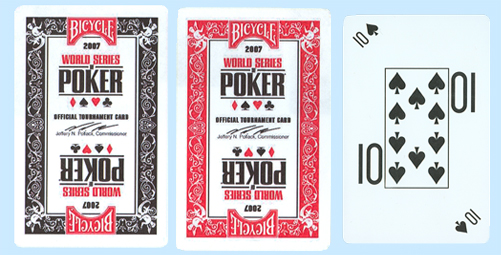
In a similar case of a lack of understanding of poker, in 2007 the Rio introduced the "WSOP Poker Peek" deck. The first time I saw them, I had two reactions: (1) I like that they're using a large index card (I'm getting older) and (2) these cards are ugly and busy. 


The idea behind these cards is that players like to peel up a corner of the card to look at it, which makes it harder for other players to see. Good concept. But take a look at the sixes and nines:


Someone apparently didn't realize that, in this context, with the numbers tilted, players have no way to distinguish a 6 from a 9. Had Caesars put these decks in the hands of just a few poker players, they would have caught this before they produced over 100,000 decks. The final result: they dumped all of these decks and had an emergency shipment of decks shipped from Kem.

One last fun fact, which really shows carelessness rather than lack of understanding of poker. Here's a larger version of the card back:

Kem WSOP back

In 2006, the WSOP created the position of "Commissioner of the WSOP" and appointed Jeffrey Pollack as its first (and last) commissioner. Jeffrey's name and signature are on these cards, but if you look closely, you'll note that his name is spelled "Jeffery." I don't think there was much chance that these cards would have survived because of the 6/9 issue in any case, but with the Commish's name spelled wrong, they were doomed.

5. Break time clusterf***. I may be hypercritical here, but when you have 5,000+ people in a confined space, there are logistical issues that really need care. I don't know that there's a good way to handle tournament breaks during the huge events at the WSOP - if you have an event with 4,000 players, and there's a break after two hours, 3,500 of those players will still be in, and at least half of them will need to pee (more in the Seniors event). But with breaks of only 20 minutes, there is no chance that players can make it to the bathroom and back. And to make the problem worse, no one has coordinated the breaks of the side events (multi-table satellites, deep stack tourneys) with the breaks of the main events, so it's entirely possible that you'll be lined up with far more players than if there were some planning. In every event I played, we had at least one and sometimes as many as four empty seats when we restarted after the break.

One possible solution: in large events, have two breaks. Table numbers 100-250 go on break now, 251-400 go on break 20 minutes into the level.

6. Hallway gauntlet. This problem got slightly better towards the end of this year's WSOP, due in part, I suspect, to my friend Nolan Dalla's intervention. Caesars has rented out space in the WSOP hallway to a variety of vendors over the years, and I'm not opposed to the idea; many of them have interesting stuff to sell. But most of the time when I'm walking down that hallway, it's either to get to the bathroom or to get back to an event. The last thing I want is to run a gauntlet that looks more like the Spice Market in Marrakech than a hallway at the WSOP. The first few days of the WSOP this year, vendors at several of the booths employed identical tactics to those that solicitors at airports use: "Excuse me, sir, is this your phone?" You look up, the guy catches your eye and now you're stuck. The other one that I heard no less than ten times during the first few days of the WSOP: "Excuse me, is that a Mophie case?" (It's an extended battery for my phone.) When I said yes the first time, I got the beginning of a pitch about how his extended battery was better. I excused myself. A few hours later, same guy, same pitch. Around the 10th time, I said, "Yes, it's still a Mophie case, just like it was when you asked me at the last break, and the previous one, and yesterday."


So given my acknowledgement of the horrifyingly complex logistics of the WSOP, is it fair or reasonable for me to level these kinds of criticism at Caesars? I think the answer is a resounding yes. From tournaments alone this year, the Rio will gross about $12 million in fees. I would guess they snare more than that in rake, although I've never estimated it. Add in food, swag, fees from vendors, ESPN broadcast rights fees and all of the other associated revenue streams, and you have a business that grosses $50 million or more over a six week period, almost all of which comes directly from the pockets of the players. We have a right to demand a high level of service, and Caesars has had more than enough time to get this right.

Are you listening, Caesars?

Thursday, June 12, 2014

Lee Jones and the Switch of Doom

DOOMSWITCH - PokerGround.com

During my tenure at PokerStars, the four questions I was asked most often were:
  1. Is there a cashout curse?
  2. Is the software random?
  3. Can you see my cards?
  4. Is there a doom switch?
Of course, these questions generally didn't take exactly these forms - they were generally expressed as facts ("Yeah, I'm running really bad on RiverStars right now because I just cashed out, but that will get better in a week or so.").

If you've been reading this blog for a while, you know that I have a great deal of respect and affection for PokerStars, even though I left the company more than seven years ago. But I suspect that you also realize that I shoot pretty straight. And since, as they say in Texas, I don't have a dog in this hunt, you should assume that the following is a mostly unbiased assessment.

Is there a cashout curse?
I definitely understand why players have come to believe this. The assumption behind the notion of a cashout curse is that online sites want to discourage players from cashing out. Using this type of indirect negative feedback could have nothing but disastrous results for us.

The two possible outcomes if we did rig the software in this way are (1) players wouldn't realize that they were being discouraged, in which case they would just decide that they were running bad, the software was rigged or (rarely) that they couldn't beat the game, or (2) players would realize that there was a 'curse,' in which case the more diligent players would start tracking it seriously, giving them evidence they could provide to the community at large.

My experience is that recreational players tend to play considerably looser once they have money in their accounts, particularly if it got there suddenly (like a big tournament win). As an example, a guy who plays small stakes cash and tournaments, who is used to having $100-300 in his account, plays the $10 rebuy tournament and wins $5,000. Most don't cash out right away; they may play bigger, or play more games, or play looser, or a combination of all of those things. Then he decides to cash out $4,000, but he doesn't revert to his prior style of play immediately. If he's a typical recreational player, he has a negative expectation, and that -EV is amplified by the fact that he's effectively playing bigger.

Verdict: No cashout curse.

Is the software random?
We struggled with this one from day one, as all online poker sites have. I've heard hundreds of stories purporting to be definitive proof that [fill in site name here]'s random number generator (RNG) isn't random, or that boards are somehow being rigged.

The usual reason I hear for the alleged lack of randomness is rake churn. It's better for [site] to have all players win roughly the same percentage of the time. The result is that all of the money circulates, but it generates more rake as it's circulating. So it's in [site]'s best interest to make sure that all players win and lose about the same amount, so the only negative liquidity is rake. The reasoning is wrong but sound, which makes the argument considerably harder to refute.

Here's the big problem with this (also with most of the other alleged means of rigging games): either (1) the software would all have to be written by Isai Scheinberg himself, (2) PokerStars would have to pay its programmers $10 million/year to keep the secret or (3) they'd have to have them all killed immediately after the code was finished. This is the problem with any conspiracy theory: it's hard to keep a secret. I can't say it any better than this:
"Three can keep a secret, if two of them are dead."
                                                              -Benjamin Franklin


One of my favorite stories related to this comes from one of my shifts in support. All PokerStars employees were required to take at least two hours of support shifts per week, a brilliant idea that really opened my eyes. I cherry-picked the questions I answered, and always looked for the ones with topics like "Got my AA cracked for the 20th time." We heard things like this so often that the programmers added a tool to the back-end system, allowing a support person to enter any hand and see the player's last n results with that hand. For example, I could specify that I wanted to see a player's last 20 hands where he started with AA.

The email, which I saved, said:
Dear Fuckstars, 
I just lost my 23rd straight hand with AA and you can stick your fucking rigged piece of shit site up your cheating fucking assholes. I also lost 12 straight flips and 6 hands in a row with AK vs A and some turd. I don't know how the fuck you guys stay in business, but you can suck my dick.
While I wasn't going to act on his suggestion, I did decide to take this particular support request. Here are his results on the preceding 23 hands in which he had AA:

Won: 18
Lost: 4
Tied: 1

That put his win rate with AA at 78%, which is pretty damn good. Oddly, his 18 wins were consecutive - meaning that he had just lost four times in a row (the tie was the last hand). That explained the tone - those four losses became amplified, and in fairness to him, the last one was excruciatingly ugly (he flopped a set vs. TT, but the board ran out four flush cards). The tie was similar - AA vs. JJ, the board ran out five cards of a suit neither had.

I examined each hand to see if there was anything specific I should mention, and I did find one fun hand in a $1-2 NLHE cash game: he had three-bet preflop and got called with two black aces. His opponent check-raised him on a flop of 678 of hearts, he reraised and the guy jammed almost $300 into a pot of less than $100. Our AA player called and found he was looking at Kh Qh, making him about a 32:1 dog. But the board ran out 8s 8c and he won; of course, he didn't mention that hand in his email. I never checked, but I suspect that the holder of the Kh Qh probably sent us a different excoriating email.

I sent him a very detailed analysis of his last 23 AA hands. Just for kicks, I also ran his last 23 KK hands. Not a whole lot there, except that he was up against AA in two of them, and managed to win them both, once flopping quads and once flopping a flush draw that came in. I mentioned this to one of our support supervisors, who said, "You'll never hear from him again, and he'll keep playing." She was right on both accounts.

On a related matter, on more than one occasion, we submitted large numbers of hands to a third party for analysis as to randomness. We're talking tens of millions of hands here, and in each case, the result was the same: there was no evidence of the hands being anything other than entirely random. And contrary to Sheldon Adelson's contention to the contrary, random number generators are able to randomize a deck of cards far better than a live dealer.

Verdict: Yes, the software is random.

Can you see my cards?
This is a tough one, and I was tempted not to even approach it. I can only answer this for PokerStars, and the answer is no. At Isai's explicit instruction, the programmers made certain that no one could see cards while hands were in progress. The tools the support team used relied on what was committed to the database, and hands weren't committed to the database until the hand was completed. To be completely honest, though, I've seen programmers do some stunning stuff over the years, so it would be disingenuous for me to say it's impossible.

The counterexample to this is UltimateBet, which was involved in the most well-publicized cheating scandal in the short history of online poker. As the story goes, their programmers created some 'superuser' accounts in the development stage so they could observe hands playing out in real time. These accounts were disabled but never fully removed from the system, and at least one of them was used by various nefarious types in the clumsiest cheating effort imaginable. So while I can speak to how PokerStars dealt with this, there's no question that there is at least some risk, particularly at sites with less to lose than PokerStars.

Verdict: On PokerStars, no one can see your cards.

Is there a doom switch?
Every time I heard this, I imagined Lee Jones in a giant, Willy Wonka-type construct, with a huge green switch, wearing a headset and awaiting instructions about who to hose. This is, in reality, the same question as "Is there a cashout curse," although it's a little more personal. Poker players need to find a reason why they're losing. The players who blame the dealer when they play live are the players who blame the software when they play online. No, Victoria, there's no doom switch, although I think Lee in a velvet coat with a giant lever in his hand is an awe-worthy image.

                                 That's Lee with the hat.

Verdict: No, there's no doom switch.